

What we’ll cover:
GPS Tracking for HVAC Companies: 6 Peak-Season Wins
It’s the busiest week of the season. Six vans are out, the phone hasn’t stopped, and a commercial account with a system down wants somebody there within the hour. You call three techs to find out who is closest, and the one who answers is forty minutes away.
GPS tracking for HVAC companies solves that specific problem, along with five others that cost you money quietly all year. The map tells you who’s closest. The history settles billing questions. The reports show where the day went.
Why HVAC companies use GPS fleet tracking
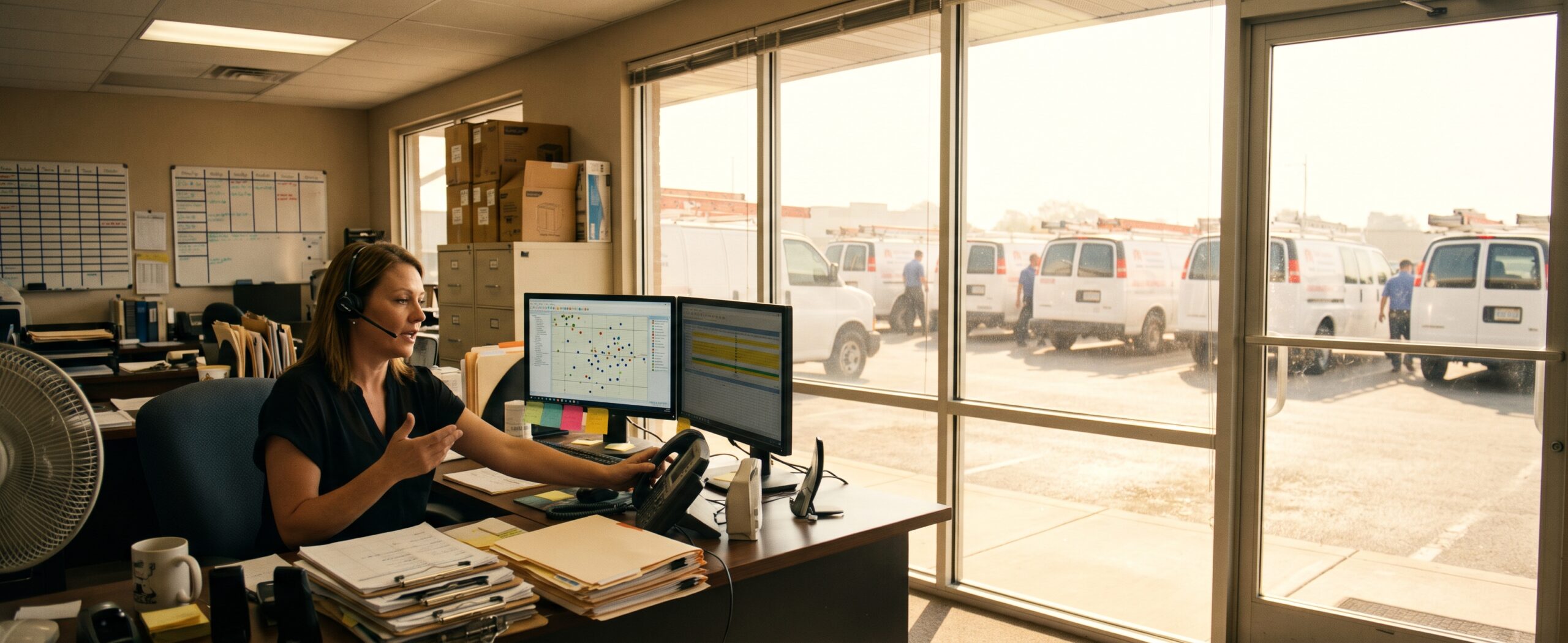
Because an HVAC operation has a particular shape. Work is unevenly distributed across the year, the emergency calls that pay best arrive with no warning, and the difference between winning and losing one is often a dispatch decision made in thirty seconds with incomplete information.
The rest of the year, the same system catches the slow leaks: drive time nobody tracks, idle hours in parking lots, service visits that never reached an invoice, and a van sitting at a supply house for ninety minutes.
Six benefits of GPS tracking for HVAC companies

1 Dispatch the closest tech during peak season
This is the one that pays for the system when the phones won’t stop.
A live map shows every van’s position, so when the no-cool call comes in, the dispatcher assigns by actual proximity rather than by who picks up the phone. On a day when you’re turning work away, routing one extra call per tech is the difference between a good week and a great one.
It also kills the phone tree. No calling three techs to locate one.
The same view helps with maintenance agreements. When a planned tune-up sits near a van that just finished early, you fill the gap instead of leaving an hour on the table, which is how shops get through a backlog of seasonal contracts without adding a truck.
2 Give customers accurate ETAs
HVAC customers wait at home for you, and the four-hour window is the thing they complain about to their neighbors.
Live tracking turns that into a real answer. Send a shareable tracking link by text and the customer watches the van approach instead of calling your office twice. Automatic notifications when a tech is on the way or has arrived do the same without anybody remembering to send them. Our guide to how fleet tracking improves customer service covers the mechanics.
The office benefit is bigger than it sounds. Every ETA call your coordinator doesn’t take is time she spends booking work.
3 Verify time on site for billing and payroll
Draw a geofence around each customer address and arrival and departure get timestamped automatically. No app for the tech to remember, no manual entry.
That record does two jobs. It settles the billing conversation when a commercial account questions four hours of labor on an invoice. And it gives you something to compare against timesheets, which in a lot of shops turns up hours worked and never billed rather than the reverse.
It also closes out the service agreement question. When a property manager asks for proof that every unit on their contract got its quarterly visit, a site report answers it in a minute instead of a search through paperwork.
4 Cut idling and fuel costs
Service vans idle. Techs run the AC through a hot lunch break and the heat through a cold morning, and neither habit shows up anywhere except the fuel card.
Idle reports show where it concentrates by location and shift rather than by name, which makes the fix a scheduling conversation instead of an accusation. Route data catches the longer version of the same problem: the supply house across town that somebody keeps driving past a closer one to reach. Our guide to reducing fleet management costs works through the math.
5 Protect vans, equipment and tools
A loaded HVAC van is a target. Recovery equipment, gauges, vacuum pumps, copper, and a work truck with a company name on the side telling everyone what’s inside.
Geofences around the yard and overnight parking flag movement outside working hours. Battery-powered trackers cover what the van itself doesn’t, which matters for trailers and for equipment and tools left on a long install. And for vehicles at high risk, an ignition cutoff feature prevents a stopped vehicle from being restarted, which is a recovery tool rather than something that touches a moving van.
Find the gaps before thieves do
Free 15-minute theft risk review. No cost, no commitment.
6 Encourage safer driving
Your techs cover a lot of miles under time pressure, and a collision costs you a van, a tech and an insurance renewal.
Speeding and harsh braking data gives you something specific to coach from. Pair it with dash cameras and you also have a record that protects the tech when a collision wasn’t his fault, which is the framing that gets crews to accept cameras rather than resent them.
Features to look for in an HVAC fleet tracking system

When comparing GPS tracking for HVAC companies, match the tool to how your shop actually runs.
For dispatch and billing:
- A live map that loads fast on a phone. Your dispatcher isn’t always at a desk during peak season.
- Geofences around customer sites, not just the yard. This is where billing verification comes from.
- A customer-facing tracking link you can text, with an expiration on it.
- Arrival and departure reports delivered on a schedule rather than built on request.
For costs, uptime and setup:
- Idle reporting by location and time of day.
- Maintenance reminders on engine hours, since a van down in peak season costs a day of your best revenue.
- Asset tracking for equipment that doesn’t ride in a tracked vehicle.
- Someone who configures it for you. The geofences for every recurring customer are the whole value, and nobody in a busy shop draws two hundred of them.
One clarification worth making: tracking is not field service software. Dispatch and scheduling platforms manage jobs, quotes and invoices. Tracking tells you where the vehicles are and what happened. Plenty of shops run both, and some tracking platforms integrate with the scheduling software you already use.
Respecting technician privacy

Your techs will have an opinion about this, and how you introduce it decides what that opinion is.
Tracking company-owned vehicles is generally permitted in the United States, though state rules differ and some require notice. Our guide to the legal side of employee GPS tracking covers the state picture, and your attorney covers your situation.
Beyond the legal question, the practical answer is to be straightforward about it. Tell the crew before installation. Explain it in terms of dispatch, billing accuracy and backing them up when a customer claims nobody showed. If techs take vans home, address personal time directly, since a private mode that suppresses location outside working hours removes the objection that actually bothers people.
How to roll it out to your techs

- Tell them first, in personA tracking program discovered in a parking lot costs you trust you won’t rebuild this season.
- Put it in writingA one-page vehicle policy covering what’s tracked, who sees it, how long data is kept and what happens outside working hours. Have everybody sign it.
- Use it to defend somebody in the first monthThe first time a timestamped arrival clears a tech of a complaint, tell the whole crew.
- Address patterns, not individualsIdle time at one supply house is a routing problem. The same data pointed at one name is a fight.
- Share something backShorter drive times and fairer route assignments are results your techs feel.
Where BrickHouse GPS comes in

We configure the platform around your operation before you log in, including geofences for your recurring customer addresses, which is the piece that turns tracking into billing verification and almost never gets done otherwise.
Service runs month to month with no contract required, support is a person who answers, and we cover vans, trailers and equipment on one map. See how it works for field service operations or talk to our team about your fleet.
Send the closest tech every time
Free demo. Month to month, no contract required.
Frequently asked questions
How does GPS tracking help HVAC companies?
GPS tracking for HVAC companies lets dispatch assign emergency calls to the closest van, gives customers accurate ETAs through live tracking links, timestamps arrival and departure at job sites for billing and payroll, surfaces idle time and inefficient routing that inflate fuel costs, and flags vehicle or equipment movement outside working hours.
Do HVAC vans need an ELD?
Usually not, though it depends on three things: the vehicle’s gross weight rating, interstate versus intrastate operation, and if the driver is required to keep records of duty status.
The federal ELD rule applies to commercial motor vehicles in interstate commerce at or above 10,001 pounds GVWR or GCWR, and short-haul exceptions exist for drivers who stay within a set radius and return to their reporting location each shift. Service vans below that weight operating locally generally fall outside it. Confirm your specific situation with FMCSA guidance or a compliance advisor rather than assuming.
Is it legal to track HVAC technicians?
Tracking company-owned vehicles is generally permitted in the United States, but state rules vary and some require notice to employees. Tracking a technician’s personal vehicle is a different matter. Put a written policy in place, tell your crew before installation, and confirm your obligations with counsel.
Can I track HVAC equipment as well as vans?
Yes. Battery-powered trackers attach to trailers, recovery machines and equipment with no power source, and report on the same platform as your vehicles. That matters on long installs where gear sits on a site overnight.
How much does GPS tracking cost for an HVAC fleet?
The cost of GPS tracking for HVAC companies depends on hardware type, monthly service per vehicle, installation, contract terms and add-ons like dash cameras. Compare the three-year total rather than the monthly rate, since hardware ownership and contract length move the number more than the headline price. Our guide to fleet tracking cost covers where the surprises hide.